
MOLLE System Explained: Complete Guide for Wholesale Buyers and Distributors
Everything wholesale buyers and tactical gear distributors need to know about MOLLE — what it is, how it works, compatibility standards, and what to look for when sourcing MOLLE gear from OEM factories.

If you are sourcing tactical gear wholesale, you will encounter the term MOLLE on nearly every product listing. Understanding what MOLLE is — and more importantly, what separates quality MOLLE construction from cheap imitations — is essential for buying products your customers will trust.
What Is MOLLE?
MOLLE stands for Modular Lightweight Load-carrying Equipment. It is a webbing attachment system developed by the US military in the late 1990s to replace the older ALICE system. The core innovation is a grid of 1-inch nylon webbing rows sewn onto vests, plate carriers, backpacks, and pouches that allows users to attach and reconfigure accessories without tools.
The MOLLE system has two components:
- MOLLE base — the horizontal rows of 1-inch webbing sewn onto a carrier (plate carrier, backpack, belt)
- PALS attachment — the vertical straps on pouches and accessories that weave through the base webbing to lock in place
PALS stands for Pouch Attachment Ladder System — this is the official name for the attachment interface. “MOLLE-compatible” and “PALS-compatible” mean the same thing in practice.
MOLLE Dimensions and Standards
For two pieces of gear to be truly compatible, they must follow the same grid dimensions. The US military standard specifies:
- Webbing width: 1 inch (25mm)
- Row spacing: 1.5 inches (38mm) center-to-center
- Column spacing: 1.5 inches (38mm)
- Stitch count: minimum 3 rows of stitching per webbing attachment point
Products that deviate from these dimensions — using 1.25-inch webbing or 1.75-inch row spacing — will technically attach but fit loosely and create instability under load. Always request dimensional specs when sampling MOLLE products from a new factory.
What MOLLE Webbing Quality Looks Like
The webbing itself can vary significantly in quality even at the same nominal spec. When evaluating samples:
- Weave density — count the threads per inch; higher density means more abrasion resistance and shape retention
- Edge finish — raw edges fray under field use; look for bartack stitching at row ends
- Stitching pattern — rows should be sewn with a box-X or bar-tack pattern, not single-line stitching
- Color consistency — webbing should match the base fabric in colorway; mismatched dye lots are a factory QC failure
Types of MOLLE-Compatible Products
MOLLE Pouches
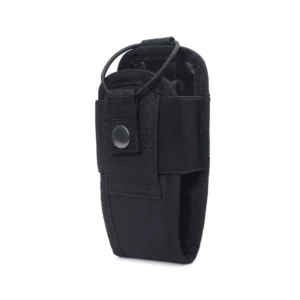
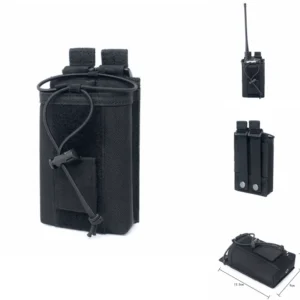
The most common MOLLE product category. Includes magazine pouches, dump pouches, admin pouches, medical pouches, radio pouches, and utility pouches. Key wholesale segments:
- Mag pouches — single, double, triple configurations for AR-15, AK, pistol
- Dump pouches — foldable mesh or nylon for spent magazines; MOQs starting at 100 pcs
- Admin pouches — document, map, and EDC organization
MOLLE Plate Carriers and Vests
The primary base for attaching MOLLE pouches. Quality indicators include full-coverage PALS grid, reinforced shoulder straps, and drag handles.
MOLLE Backpacks and Packs
3-day assault packs and hydration carriers with front MOLLE panels for attaching accessories. A fast-growing segment for law enforcement and outdoor wholesale buyers.
MOLLE vs. Non-MOLLE: What Wholesale Buyers Should Know
| Feature | MOLLE System | Fixed-pocket Design |
|---|---|---|
| Configurability | Fully modular | Fixed layout |
| End-user appeal | High (military, LE, enthusiasts) | Moderate (casual outdoor) |
| Margin potential | Higher — accessory ecosystem | Lower — standalone product |
| Factory complexity | Higher — webbing alignment critical | Lower |
| Amazon search volume | High for “molle pouch”, “molle vest” | Low |
Sourcing MOLLE Gear: Factory vs. Trading Company
Because MOLLE webbing alignment requires precise sewing machine calibration, quality variation between factories is significant. A factory with dedicated MOLLE production lines will produce consistent row spacing across a 1,000-piece run. A trading company sourcing from multiple workshops cannot guarantee this.
When vetting a MOLLE gear supplier:
- Request a photo of the sewing floor showing the MOLLE attachment station
- Ask whether they sew webbing in-house or outsource it
- Measure webbing spacing on your sample with a ruler — deviation of more than 2mm indicates inconsistent production
- Pull-test the webbing by hand; it should not deform or pull threads under firm hand tension
Panoar manufactures MOLLE tactical pouches in-house with 10+ years of production experience, supplying distributors and brands in 50+ countries. All MOLLE webbing is sewn to US military dimensional standards with bartack reinforcement.
Common MOLLE Product Mistakes Wholesale Buyers Make
- Ordering off photos alone — MOLLE webbing quality is invisible in product photos. Always sample.
- Ignoring weight specs — A 1000D Cordura pouch should weigh more than a 500D version of the same design. If it doesn’t, the fabric weight is wrong.
- Skipping compatibility tests — Attach your sample pouches to your sample plate carrier before approving bulk production. Confirm the PALS straps weave and lock correctly.
- Overlooking color matching — Coyote Brown from one factory often doesn’t match Coyote Brown from another. Coordinate across your product line if running a set.
Frequently Asked Questions About MOLLE
What does MOLLE stand for?
MOLLE stands for Modular Lightweight Load-carrying Equipment. It is a US military-developed webbing attachment system that allows tactical pouches and accessories to be attached and repositioned on vests, plate carriers, and packs without tools.
Is MOLLE compatible with all tactical vests?
MOLLE pouches attach to any gear using the PALS (Pouch Attachment Ladder System) webbing grid. As long as both the base and the pouch follow standard 1-inch webbing with 1.5-inch row spacing, they are compatible. Non-standard spacing causes loose fit.
What is the difference between MOLLE and PALS?
MOLLE is the overall equipment system. PALS (Pouch Attachment Ladder System) is the specific webbing attachment interface. In practice, “MOLLE-compatible” and “PALS-compatible” mean the same thing — both describe gear that uses the 1-inch, 1.5-inch-spaced webbing grid.
What is the minimum order for MOLLE pouches wholesale?
Most China OEM factories that produce MOLLE gear require 100–500 pieces per SKU for standard colorways. For custom colorways or logo additions, expect a 100–200 piece MOQ minimum. Panoar offers 100-piece MOQ on all standard MOLLE pouch SKUs.
How do I tell if MOLLE webbing quality is good?
Measure row spacing (should be 1.5 inches center-to-center), check that row ends are bartack-stitched, and hand-pull the webbing — it should not deform. On a sample, weave a PALS strap through the rows; it should snap in firmly with no looseness under load.
What fabric is used for MOLLE tactical gear?
Quality MOLLE tactical gear uses 500D or 1000D Cordura nylon (Invista-licensed) for the base fabric. The webbing itself is 1-inch nylon mil-spec webbing. Budget products often use unlicensed polyester fabric that mimics the look but lacks Cordura’s abrasion resistance.