

MOLLE Webbing Spacing Guide for Tactical Gear OEM Buyers

OEM Tactical Gear Guide
MOLLE webbing spacing is one of those details buyers only notice when it goes wrong. A pouch may look clean in photos, but if the PALS grid is uneven, the strap can feel too tight, too loose, or difficult to weave across a backpack, vest, belt, or plate carrier.
If you are developing MOLLE pouches, plate carriers, tactical belts or backpacks for production, confirm the spacing during sample review before bulk order. The goal is not only to match a drawing, but to make sure real pouches attach smoothly and repeat orders stay consistent.
Why MOLLE Spacing Matters Before Bulk Production
MOLLE is the modular attachment system used on many tactical backpacks, vests and plate carriers, utility pouches, duty belts, and field bags. PALS is the webbing grid that allows MOLLE pouches and attachments to connect to the platform.
For importers and private-label buyers, this is not only a design point. It affects sample approval, pouch compatibility, sewing quality, buyer complaints, and repeat-order consistency. A reliable tactical gear manufacturer should treat the webbing grid as a production standard, not just as decoration.
MOLLE Webbing Spacing and PALS Webbing Dimensions
The common PALS layout uses 1 inch webbing, about 1 inch row spacing, and roughly 1.5 inch vertical stitch intervals. Buyers should still confirm tolerance in their own tech pack, but these figures are useful when discussing a custom MOLLE pouch OEM project with a factory.
| Specification | Common Reference | Factory Check |
|---|---|---|
| Webbing height | 1 inch / 25.4 mm | Measure after dyeing, coating, and cutting because webbing width can vary slightly. |
| Row spacing | About 1 inch / 25 mm | Check the gap after sewing, not only before sewing, because fabric tension can shift the row. |
| Bartack interval | 1.5 inch / about 38 mm | Keep loop width consistent so attachment straps do not bind or twist. |
| Practical loop range | Often checked around 35-40 mm | Confirm with the buyer’s approved pouch or platform sample. |
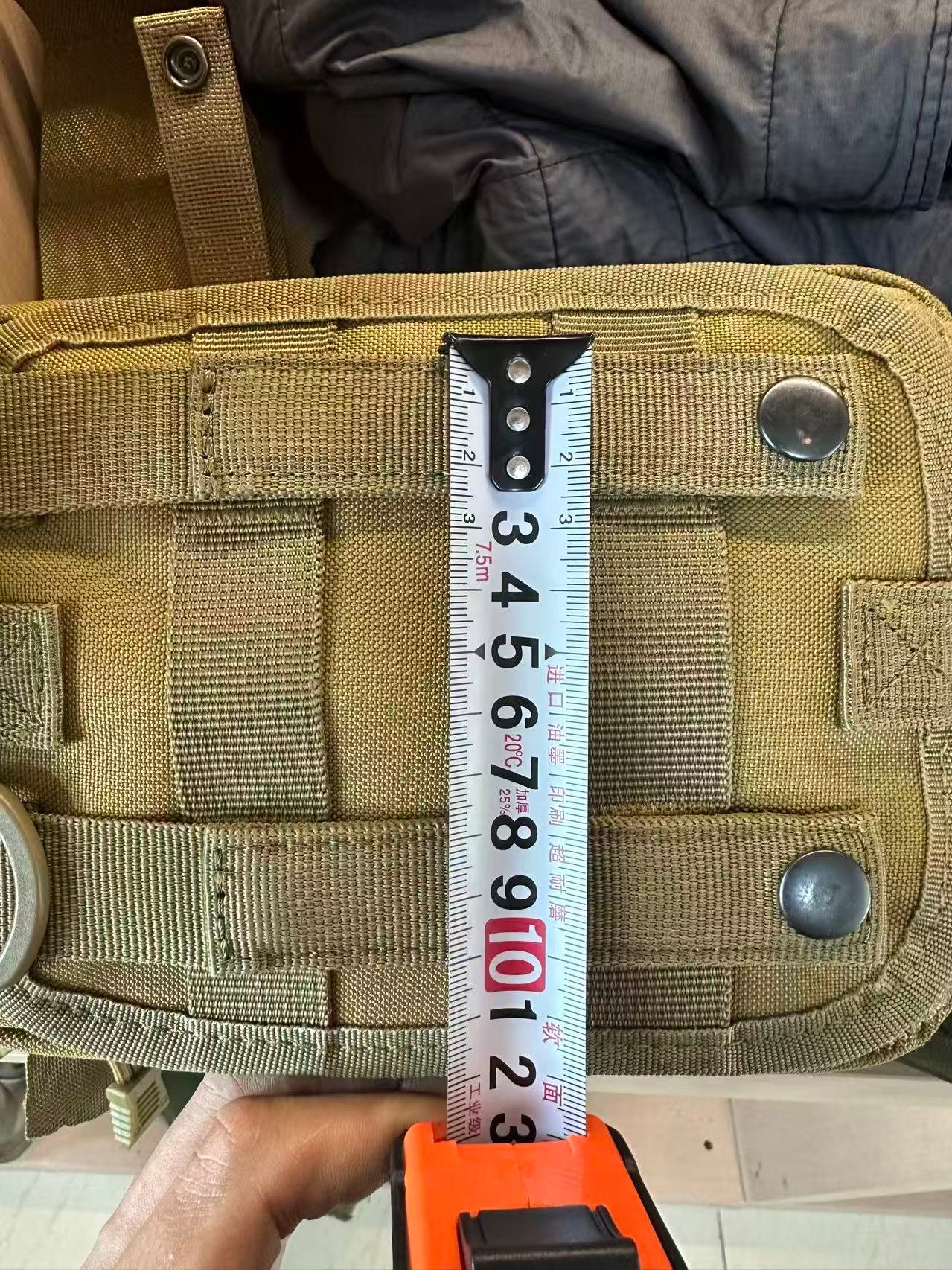
A ruler check is useful, but it is not enough. During sample review, the factory should attach a real pouch to different areas of the panel and confirm how the strap feels when woven through the grid.
How PANOAR Checks MOLLE Spacing Before Production
For OEM projects, PANOAR reviews MOLLE spacing as part of sample development and pre-production checking. The process is practical: the team compares the approved sample, checks webbing alignment after sewing, and tests whether real pouches can be attached without forcing the straps.
Sewn Webbing or Laser-Cut MOLLE?
Traditional sewn webbing is still common on tactical backpacks, MOLLE pouches, waist packs, belts, and larger modular bags. It is easy to inspect and familiar to most distributors.
Laser-cut MOLLE is often used on plate carriers, lightweight panels, and low-profile gear. It can reduce bulk and give the product a cleaner surface, but the buyer still needs to check slot spacing, fabric stiffness, lamination quality, and long-term shape retention.
If your line includes both sewn MOLLE and laser-cut MOLLE, ask the factory to test the same pouch across both panel types. A good-looking laser-cut panel is not useful if common MOLLE compatible pouches are difficult to insert.
Common OEM Mistakes Buyers Should Watch For
Most MOLLE issues are small at first. They become expensive only after the buyer receives a full batch and starts checking real attachment.
- Uneven row alignment: The webbing looks acceptable from far away, but long pouches do not sit straight.
- Inconsistent bartack stitching: Some channels become too narrow, while others become too loose.
- Wrong material stiffness: Soft webbing or weak laminated panels can deform after pouch insertion.
- No real attachment test: The sample passes visual inspection but fails when paired with actual pouches.
- Poor repeat-order control: The second batch does not match the original approved sample.
This is why a MOLLE pouch manufacturer should keep an approved sample, check webbing guides during sewing, and review pouch fit before final packing.
What to Send When Requesting a Quote
If you want faster pricing from a tactical backpack manufacturer, plate carrier manufacturer, or custom pouch supplier, send a clear brief instead of only asking for a unit price. For projects with specific webbing, buckles, fabric, zipper pulls, or color matching requirements, it also helps to review the factory’s custom materials and hardware options before sample development.
- Product type, such as tactical backpack, MOLLE pouch, plate carrier, belt, organizer pouch, or waist bag.
- Target size, fabric, padding, webbing, zipper, buckle, and attachment layout.
- Color requirement, including black, coyote, ranger green, camouflage reference, or brand color.
- Logo method, such as woven label, rubber patch, embroidery, printed logo, or removable patch.
- Estimated quantity, destination country, packaging requirement, and target timeline.
- Reference photo, drawing, current sample, or tech pack if available.
PANOAR supports OEM and ODM tactical gear manufacturing for importers, distributors, and private-label brands. A complete brief helps the factory check feasibility, quote more accurately, and reduce sample revisions.
Planning a Custom MOLLE Gear Project?
PANOAR supports OEM and ODM development for MOLLE compatible pouches, tactical backpacks, plate carriers, utility pouches, working dog gear, and private-label sewn products. Send your reference and quantity plan through the tactical gear RFQ page for a factory review.
Conclusion
MOLLE webbing spacing should be confirmed before bulk production, especially when the product needs to work with existing pouches or a full modular product line. The best result comes from clear PALS webbing dimensions, stable bartack stitching, real attachment testing, and a factory sample that becomes the standard for repeat orders.
FAQ
What is the standard MOLLE webbing spacing?
A common reference uses 1 inch webbing, about 1 inch row spacing, and about 1.5 inch bartack intervals. Buyers should confirm final tolerance with their approved sample or tech pack.
Are MOLLE and PALS the same?
They are closely related. MOLLE is the modular equipment system, while PALS refers to the webbing grid used to attach compatible pouches.
Can laser-cut MOLLE work with regular MOLLE pouches?
Yes, if the slot spacing, material stiffness, and panel construction are correct. Buyers should test real pouch attachment before approving bulk production.
What should I check before ordering custom MOLLE pouches?
Check pouch size, fabric, strap width, webbing alignment, bartack placement, stitching strength, logo method, color matching, packaging, and platform compatibility.
Can PANOAR make MOLLE spacing based on my sample or tech pack?
Yes. Buyers can send reference photos, drawings, a tech pack, or a current sample. PANOAR can review the MOLLE layout, material direction, sample feasibility, MOQ direction, and bulk production requirements before quotation.

[…] the MOLLE webbing spacing guide before approving […]
[…] For MOLLE compatibility, attachment details matter as much as the front shape. Buyers should check strap width, row spacing, bartack position, panel stiffness and whether the pouch attaches smoothly to backpacks, belts, plate carriers or other platforms. For spacing details, see the MOLLE webbing spacing guide. […]
[…] MOLLE fit is an important selling point, buyers can also review the MOLLE webbing spacing guide before finalizing drawings or sample […]
[…] Procurement note: this page should own the tech-pack checklist intent only. For pouch style comparison, use the MOLLE pouches for tactical bag sourcing guide. For spacing details, use the MOLLE webbing spacing guide. […]
[…] a related webbing reference, see the MOLLE webbing spacing guide. The final dimensions and attachment requirements still need to be confirmed against the selected […]
[…] A product photo alone cannot confirm compatibility. Buyers should review the actual webbing layout, attachment strap design, stitch consistency and the fit between the selected pouch and platform. For detailed spacing and production checks, see the MOLLE webbing spacing guide. […]
[…] the MOLLE webbing spacing guide when checking the technical side of a modular layout. The backpack tech pack should remain focused […]
[…] technical spacing context, see the MOLLE webbing spacing guide. The final attachment layout still needs to be checked against the selected harness […]
[…] MOLLE spacing reference can support the measurement review, but the approved product sample remains the working reference […]
[…] MOLLE/PALS spacing requirements, use the separate MOLLE webbing spacing guide. Keep those grid dimensions distinct from the dimensions of an individual strap […]